Sunday, May 25, 2014

THE "TRAILS" AND THE "TRIALS" -- the 2014 CES TOUR

Each year we have the special privilege of having officials from the Church Education System (CES) come here to teach us all they can about the Mormon Trail.   This year Kyle Anderson and Clint Udy came to teach us, beginning with a wonderful fireside after our Sunday Pot Luck dinner.  

During the fireside they had missionaries hold up signs with the names of locations along the trail and arrange them in the proper geographical order from East to West, finishing with Salt Lake City.  Then other missionaries holding the names of the Willie, Martin, Hodgetts and Hunt Companies positioned themselves on the east, while missionaries holding the names of rescuers formed at the west.  Kyle then took us day by day of the rescue, and had the appropriate companies and rescuers move towards each other, passing key locations along the way until they met and all arrived in the Salt Lake Valley.

My great, great grandfather, Reddick Newton Allred was the rescuer in charge of the supply wagons stationed at South Pass waiting for word of the missing handcart companies.  Elder Moench's great, great grandfather Joel Parrish was in that same group - they knew each other!

Some of those rescuers became fearful that they too would starve or freeze to death and turned back to Salt Lake.  But Reddick Allred stayed right there in the snowy blizzards and earned the nickname of "the Bulldog" for remaining true to his assignment.  He was able to bring supplies and give much needed help and support to both the Willie and the Martin Handcart Companies.
The following day almost all of our missionaries happily boarded two large buses and headed out on the trail.  In addition to having Kyle on one bus and Clint on the other, Jolene Allphin came clear from Utah to join us on our road trip.  Elder Moench and I didn't think there would be room for the two of us on the bus, but at the last minute, one couple didn't feel well and stayed home, so we got the last two seats in the back.

Our first stop was Deer Creek, about 80 miles east of Martin's Cove, where the Martin Handcart Company, realizing how very late they were, tried to lighten the load on their handcarts so they could make better time along the trail.  They discarded and burned many of their warm quilts, blankets, and winter clothing.  The weather had been warm, and they did not know it would begin snowing two days later on October 19, 1956.  Sadly, many of those items might have have saved lives.
We then went to Reshaw's Bridge, the Anglicized pronunciation of the last name of Frenchman John "Richard."  Had they been able to afford to cross the North Platte River on this bridge, members of the Martin Company might not have been so wet and frozen as they forded the river and were caught in the snowy blizzard that began that day and took the lives of 14 people.

It was a much nicer day this year when we visited it.

Lots of money was made for the owners of this and other bridges and ferries along the way, and as you can see by the last quote, they charged the Mormons as much as they could.

We all ate lunch together at Fort Caspar out in their lovely picnic area. 
(The city of "Casper" is actually a misspelling of that name.)

There were no tables left when we were finally ready for lunch, so we got to eat on the playground in the stagecoach.  The Freemans and the Ereksons also ate on the playground equipment.

Our next stop was Bessemer Bend where the Martin Company hunkered down close to the river for 5 days in the deep snows.  The storm raged, and they were on such severely reduced rations that 56 of them died here of starvation, exhaustion, and freezing temperatures.  

Today was a totally different story - sunny and warm with kayakers enjoying the North Platte River.

We were finally able to visit the Avenue of Rocks, a long line of jagged rocks and peaks that crosses the trail here.  Weeks ago we and a few others had passed this on our "Great Mud Adventure," but we were trying to maintain momentum up the hills and were not able to stop and see this unique formation.

Our last stop along the trail was at Greasewood Creek, named after a variety of sagebrush.  Here the first rescuers with supply wagons finally met up with the starving, freezing Martin Handcart Company.   When the beleaguered saints came into camp here, the rescuers already had large fires burning to give them some warmth and a little food.

We also returned to food and comfort after our long day's journey, and we were very appreciative of the delicious meal prepared by the Ames and the Thomases who have perfected the art of cooking for very large groups and serving us all in record time.

The following day we began the second leg of our training at the Sixth Crossing Trek Center where Kyle and Clint and Jolene taught us more of the Willie Handcart experience, Again, none of us can comprehend the unimaginable circumstances these pioneers were in when the rescuers found them hunkered down in the willows and out of food. 

We headed out in many trucks and other vehicles and first visited the meadow where the Willie Handcart Company took shelter from the wintry storms while their beloved Captain and Joseph Elder rode to find the rescuers.

Clint told us about the rescue from the viewpoint of Captain Willie as he returned with rescue wagons over this "eminence" and found that his beloved handcart pioneers were still there in the meadow below.  He must have shed tears of joy to see them still alive.

We then rode in about 30 trucks up to the Lower Monument honoring the pioneers who died in the valley below and marking the beginning of the "trail" and the "trial" up and over Rocky Ridge, a journey that took many of them until the early morning hours of the following day.  Jolene, Clint, and Kyle each spoke to us about the climb over this difficult part of the trail.

Finally the Willie Company reached their camp at Rock Creek, although 13 people died during that cold and snowy  climb.  They are buried here in a mass grave dug by two other men who died later the same day and are buried here also.  The trail coming down the hill and into camp is still visible.
Not one of us living today has ever been as hungry or as cold or as exhausted as these dear pioneers who gave their all to get their families to Zion!

We owe them such a debt of gratitude for their great and faithful example to all of us!


Thursday, May 15, 2014

THE WILLIE ROOM AT THE RIVERTON STAKE CENTER

This week we went to Riverton with the missionaries from Sixth Crossing to visit the Willie Room at their stake center.  

This is the stake that was responsible for the Second Rescue, and after all these years they have collected enough memorabilia to fill an entire classroom with pioneer artifacts, pictures, and information about both the Martin and the Willie Handcart Companies.  Their efforts to ensure that all those handcart pioneers had their temple work done and recorded properly are documented in the book, "Remember."

On the table in the high council room is a beautiful bronze sculpture depicting Jens and Elsie Neilsen pulling their handcart with their little 6 year old son Neils and 10 year old Bodil Mortensen walking next to them in the snow, and then 11 year old James Kirkwood carrying his little 4 year old brother Joseph walking behind them.  Neils, Bodil, and James all perished as the Willie Company crossed Rocky Ridge in a blizzard, and they are buried in a mass grave at Rock Creek Hollow.


The second bronze stature represents the death of Bodil Mortensten who was found as she sat by the campfire, frozen to death after crossing Rocky Ridge.

Sister Amy Phister, wife of the current Riverton Stake President, was there to speak to us.  In addition to telling the story of how their stake took on this herculean task, she showed us a beautiful and meaningful quilt she had made at the time of the sesquicentennial celebration.  Each of the blocks represents a phase of the journey of the Martin and Willie Handcart Companies as they struggled through early winter snows to get their families to Zion.

Then she took us in small groups into the "Willie Room" where we could see the rows and rows of binders full of genealogical records and information for each of the handcart pioneers.


The room also included the original molds and other items used to make the bronze plaques on the monuments at Martin's Cove and Rocky Ridge.  We have heard the story from President Lorimer, so it was really great to be able to see the molds, the horn that the handcart motif was carved from, and even the pourings that failed. 

There were lots of other interesting items as well, including a picture of the little shoe from the Gadd twin who died along the trail, a photo of President Hinckley, who was so instrumental in acquiring this historic site, and an original "No Trespassing" sign that kept members of the church from visiting Martin's Cove for years until those lands were purchased from the Sun Family in 1996.

There were also two fascinating photos from 1942 showing the entire Homestead area of the Sun Ranch under water as the Sweetwater River overflowed its banks and flooded the Barn and even the Sun Family Home.  (I could only photograph it through a glass case, so there is a lot of reflection.)
The service rendered by the Riverton Stake not only in behalf of the Martin and Willie Handcart Companies, but for all of us in acquiring, maintaining, and preserving the lands now owned by the church cannot be measured.  We all own them an enormous debt of gratitude.  Without their efforts, there would be no Mormon Handcart Historic Sites!


Monday, May 12, 2014

A MOTHERS' DAY TO REMEMBER!!

Mothers' Day is one of the hardest days when you are away from your children, which is what happens to all of the mothers serving missions.  During the week leading up to it we sang lots of songs in our Correlation Meetings about Love at Home and Mother, I Love You.  

On one of those mornings we sang I Often Go Walking, which talks about remembering your mother when you walk through meadows of flowers, and as we sang it Sister Paulsen, who had chosen that song and was leading it, grabbed my hand and made me stand up.  I had been sitting on the front row, but as I stood up and turned around I saw that every elder in the chapel was standing and had flowers in his hand.  As we continued to sing the song she had me walk along the aisle and each elder handed me his flowers.  By the time I had walked all the way through the chapel, I had “armfuls of flowers.”  It was SO sweet!!  I went up to the microphone and thanked “all my children” for such a thoughtful Mothers’ Day gift, and told them how much my own mother loved flowers and how we had sung that very song at her funeral.  What a touching thing for them to do! 
Later that day I received a wonderful Mothers' Day gift from my family - a darling picture of all 19 of our grandchildren!  By the time we return home from our mission our oldest grandson will already be out serving on his own mission, so I don't know when we'll have all of them together again.

I had been planning my own Mothers' Day gift for all the sisters, and I made little handcart earrings for the new sisters and gave each of the second year sisters a trek necklace to wear.  Many have asked about them, so I hope they will enjoy this little memento from serving at MHHS.
On Mothers' Day we awoke to a dreary snowy morning.  It wasn't snowing hard, and it wasn't accumulating on the roads, but it was windy and cold.  We had our regular three hour block of church meetings and afterward shared a delicious Pot Luck dinner made especially for all the mothers by their husbands. 

Then we all returned to the Trek Center for a fireside with Jolene Allphin, author of Tell My Story, Too.  She brought beautiful banners showing maps of the trail that all the pioneers followed, and talked about events in the lives of the handcart pioneers as they came along that same trail. 
Towards the end of her presentation she talked about Joseph A. Young, the oldest son of Brigham Young who went out from Salt Lake as a rescuer.  Many pioneer journals describe how he rode a white horse down a snowy hill and into their camp while wearing a blue military coat.  Several pioneers had received dreams where they saw a rescuer dressed exactly like that, and it happened just the way they had seen it in their dreams.  

Jolene had some of the elders come up and model a blue wool soldier's coat she made to look like the one Joseph A. Young might have worn would have worn as he rode in to rescue the beleaguered handcart pioneers.

It was a wonderful fireside, and afterward Jolene stayed to visit with the missionaries about their own personal pioneer ancestors and to sign their copies of her book, which we refer to constantly in our efforts to come to know and tell those pioneer stories.

But then we got some disturbing news.  We knew it had been snowing all day long, but nothing had really accumulated on the roads, so we were shocked to learn that all the highways had been closed heading back to Sixth Crossing. (When snow falls in Wyoming, they just put the snow arms down and close the roads.  If someone drives around those snow arms they incur a $750 fine and/or jail.)  

The 20 missionary couples from Sixth Crossing could not return to their homes!
So we decided to do just what Brigham Young did when the handcart pioneers finally arrived in the Salt Lake Valley - we made certain that each couple from Sixth Crossing got to stay in the trailer or mobile home of one of the couples at Ranch 66, which is the Missionary Village for the couples serving at Martin's Cove.  Elder Bigler found out who had extra bedrooms, and he assigned everyone out.

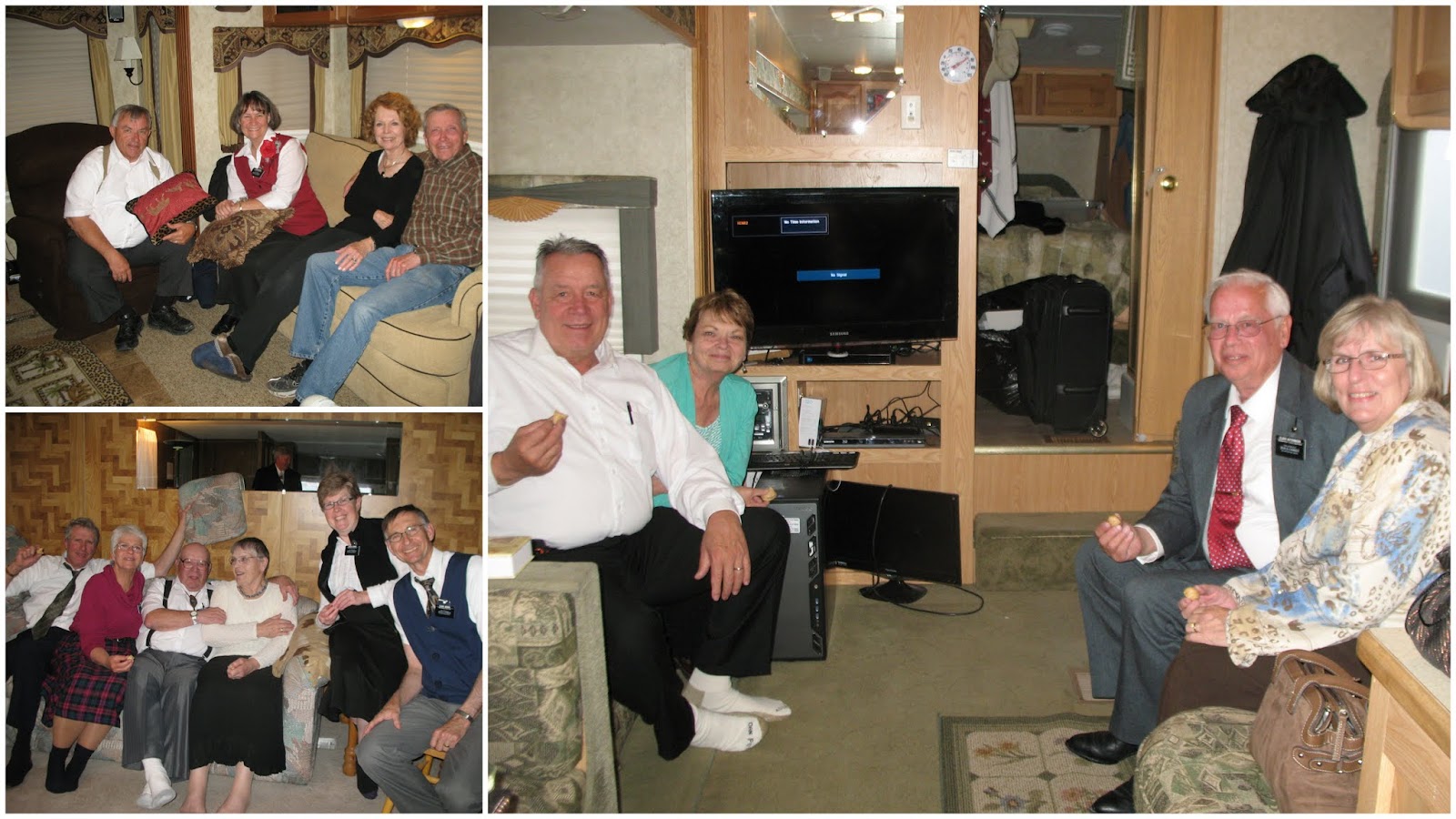
Elder Moench and I visited as many people as we could before it got dark - just to see how they were all doing.  We took them some peanut butter candy made by Elder Bushman or some popcorn. 

Everywhere we went they were already settled in, playing games with each other, visiting and getting to know each other better, making the best of it all.  


We were concerned about some of our missionaries who (since they had not planned to stay overnight anywhere) did not have the medications they needed, but most were able to borrow something here and there from other missionaries. 


It's supposed to continue to snow tomorrow, and we have no idea how long it will be until the roads open, but until they do, our Sixth Crossing missionaries are being really good sports about being displaced, and our Martin's Cove missionaries are being excellent hosts. 
As you can see, they're actually having a lot of fun being together and making lemonade out of a lemon!
The next morning looked dreary again, but at least the snow had stopped.  Multiple times we checked WDOT to see if highway 789 was open yet.  One by one other highways had been opened, but the one to Sixth Crossing was still closed.  At 8:30 everyone met together at the Pavilion for a quick Correlation Meeting, and E Moench asked them to share some of their experiences and thoughts about the previous night and what they had learned from it all.
There were lots of funny answers like, "I learned I need to keep a toothbrush in my car," and "I learned I could actually brush my teeth with toothpaste and my finger" and more serious observations like "I will always carry some of my medications in the car."  But there were also many expressions of love and appreciation to those who took in "new friends" for the night.  We would never have intentionally planned a joint sleepover like this, but nature did it for us, and missionaries from both sites got to know each other one on one that evening.  
That said, we all celebrated when the word finally came that the road was finally open and our dear missionaries from Sixth Crossing could finally return home!      
This was truly a Mothers' Day like no other!! 

Sunday, May 4, 2014

TWO SESSIONS OF TREK LEADER TRAINING THIS SPRING!

For two weekends in the Spring and another three weekends in the Fall we hold Trek Leader Training.
Leaders of trek groups are required to attend one of these sessions in order to bring their groups here.  We have many stake and ward youth groups, but we also have ward family treks and many family reunions.

In preparation for their arrival our missionaries already had the handcarts out and ready for the Trek Leaders to pull.
We start out at Martin's Cove where they all come to register, get a packet of information, and a nametag showing us where they are from.
Then we all meet in the Trek Center - a large, log building that can hold about 300 people - and they are given an overview of what will be taking place for the next 2 days.  This time we were treated by a harmonica playing a solo of Come, Come, Ye Saints.  Then we watched a video produced by one of the Spanish Fork stakes after they came last year.  It is very well done and gives the trek leaders a great example for their own trek experience.
Just before the trek leaders left the building, Elder Bushman, our Trek Coordinator, set the mood for the trek by talking about how difficult it was for those freezing, starving, exhausted pioneers to even cross the little stream known as Pete's Creek.  

Then everyone got a chance to do just that as they began their trek.

These trek leaders got trained on how to handle a medical emergency . . .

. . . and how long it takes to get 250 people through a potty stop (about 45 minutes.)

Then they did a Women's Pull and then went to one of the river crossings where one of the sisters was stationed there playing Come, Come, Ye Saints on her flute.  The river was deep, fast, and cold, so we did not encourage our trek leaders to cross, although a few did it anyway.

They came over Footbridge instead.

They were shown the statues sculpted in 2006 by Rusty Bowers to represent the young men from Salt Lake - "the Valley Boys" - who carried many of the weary members of the Martin Company across the Sweetwater River, which was full of ice that day, so they could take refuge in Martin's Cove.

Everyone ate lunch at Handcart Parking and then left their carts behind as they first listened to stories at Dan Jones Amphitheater and then headed up into Martin's Cove.

They spent a few minutes at the tip of Martin's Cove looking out over where those handcart pioneers would have camped, and trying to imagine the destitute conditions they were in.

Then everyone headed back down the other side and met at the Cove Overlook for a few more stories and the chance to look out over the vastness of the Wyoming plains - exactly the view the handcart pioneers would have seen.
In the evening we were all treated to a wonderful meal prepared by our excellent cooks, and we trained them all about how to dress on their treks, what kinds of medical personnel and vehicles they need to bring, how to prepare simple but nutritious meals for their groups, and how to have a fun experience with the Pony Express.  Finally we took them out and taught them how to square dance so they can teach it to their group members.

The following day - Saturday - we did a different kind of presentation at Sixth Crossing so the Trek Leaders had a chance to visit both sites.  Elder Moench spoke and went over the Trek Guide, Sister Bushman and Sister Martin spoke, and another wonderful trek video was shown.  Then we did a Readers' Theater with journal entries from some of the handcart pioneers, and finished with Come Take Your Place, a presentation inviting some of the Trek Leaders to come up front and represent all of them as it is now time for them to go home and prepare for their upcoming treks.  Everyone did such a wonderful job, and we hope it helped and inspired all those Trek Leaders.


ONE LAST LITTLE ADVENTURE -- IN THE MUD!

Several of us wound up going into Casper at the same time last week, and rather than just take the regular drive on the highway, we all decided it would be fun to go along the actual trail past Prospect Hill, over to Avenue of Rocks, and come out by Bessemer Bend. 

We started out just fine and were able to follow the trail and see the historic markers along the way.  It had been dry and windy for the past few days, and we were surprised to see snow along the trail.

When we came to Willow Springs we couldn't resist taking a picture of this old, old tree that was probably living when the pioneers came through.


And then the real fun began . . .

Because of the overnight snow, the dirt road (which had appeared completely driveable when we started out) suddenly became one giant mud pie. 
How I wish I could have taken a little video clip of everyone slipping and sliding 
-- first sideways one direction and then sideways the other direction -- 
as we all tried to get up just the smallest inclines along the way.  
Anyone watching us would have thought we were all drunk drivers!  
 I tried to take a picture of the 6" of mud hanging down off our side mirror, but it fell off just before I clicked the camera.
 

There were times when we thought we were going to have to call back to the Homestead for help.  Each vehicle came dangerously close to sliding off the road and into the ditches on either side.  No one even had a tow rope!  
Eventually we all made it through the soupy mud, although we did have to leave behind one of the trucks that was pulling a trailer.  It was safely pulled over along the side of the road, but it will have to be a drier day when they come back for it.
We decided to celebrate surviving the muds of Wyoming by going to Qdoba for lunch, and you should have seen the muddy footprints we tracked into that restaurant after our adventure
in the MUD!